


Let's talk about milliseconds and millions of dollars. When your 50,000-GPU cluster crashes at 3 AM Singapore time, the difference between a field engineer arriving in 4 hours versus 24 hours equals computational work worth months of research—and enough opportunity cost to make your CFO weep into their quarterly reports.
Welcome to the reality of 2025's AI infrastructure, where geography shapes destiny and proximity determines profitability. Data centers now consume 55 gigawatts globally, with AI workloads projected to drive a 165% increase in power demand by 2030. The race to build capacity has never been more urgent.
The Numbers That Matter: 257 Locations Spanning Tomorrow's AI Hotspots

Introl just launched our interactive global coverage map, which reveals a strategic footprint that reads like a roadmap to the future of computing: 257 service locations sitting precisely where companies will build the next trillion dollars of AI infrastructure.
Here's the geographic reality shaping your infrastructure decisions:
-
EMEA: 156 locations across 78 countries (including emerging Eastern European hubs where power costs remain competitive)
-
NAMER: 64 locations covering North America's mature markets (where grid connection wait times now stretch 4-7 years in Virginia)
-
APAC: 46 strategic positions throughout Asia-Pacific's exploding ecosystem (where $37 billion in new investments will add 8GW of power capacity)
-
LATAM: 32 locations supporting Latin America's computational awakening (with Brazil and Argentina emerging as cost-effective alternatives)
Each pin represents more than coordinates—these locations anchor humanity's ability to train tomorrow's AI models, discover breakthrough drugs and push silicon to its limits.
Why Southeast Asia and Emerging Markets Define Your Next Move
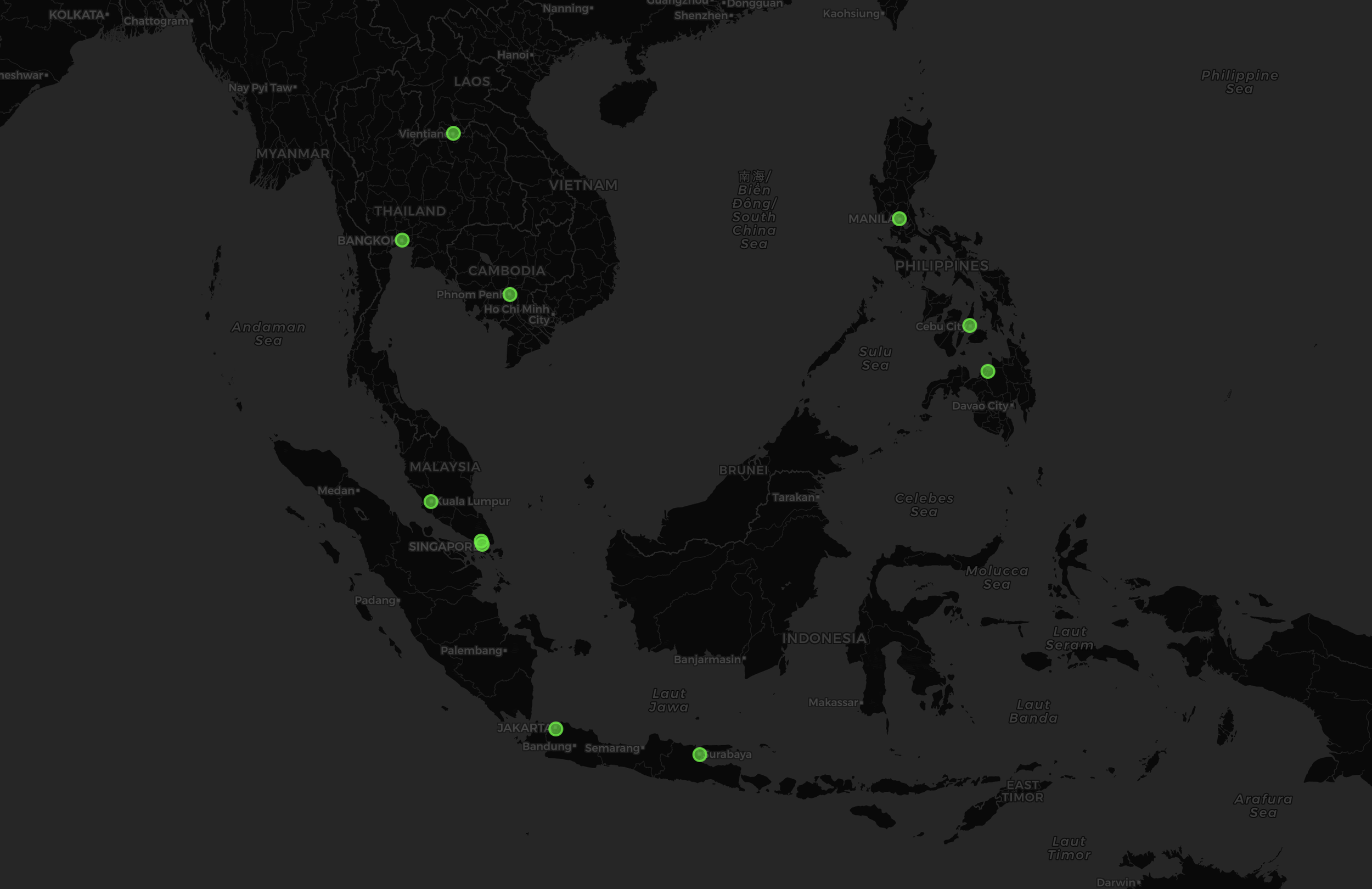
The data center world's center of gravity shifts eastward daily. Southeast Asia's data center market will more than double from $5.42 billion in 2024 to $11.80 billion by 2030, growing at a 13.84% CAGR. Malaysia's Johor province alone attracts billions in hyperscale investments, while Microsoft commits $1.7 billion to Indonesian AI infrastructure and Google pledges $1 billion for Thailand.
Our coverage follows the money—and, more importantly, the opportunity. When data sovereignty laws in Malaysia, Vietnam, and Indonesia mandate local data storage, your infrastructure partner should have boots on the ground before contractors pour the concrete.
The Interactive Edge: Intelligence at Your Fingertips
Static coverage maps died with the advent of dial-up internet. Our interactive platform transforms geographic data into strategic intelligence:
Filter by Real SLAs: Do you need a 4-hour response for your mission-critical Singapore deployment? The map instantly highlights coverage across the region—no guesswork, no sales promises, just facts.
Explore Regional Depth: Jakarta, West Java, and Batam emerge as Indonesia's data center triangle, each with unique power profiles and connectivity advantages our teams know intimately.
Plan Smarter Deployments: Visualize coverage before you commit capital. Thoughtful planning beats emergency scrambling when hyperscalers lease all new capacity in primary markets before contractors complete construction.
Modeling Future Scenarios: Considering Bangkok's Booming Tech Scene? Type it in, see our capabilities, and make informed decisions backed by local expertise.
For Hardware Suppliers: Your Gateway to Global Deployment
Hardware manufacturers face a stark reality: analysts expect data center occupancy rates to peak above 95% by late 2026. Your cutting-edge cooling systems, next-gen GPUs, and power infrastructure need deployment partners who understand both the technology and the terrain.
Our field engineers don't just install equipment—they navigate:
-
Local power grid idiosyncrasies (crucial when liquid cooling becomes mandatory for 50kW+ rack densities)
-
Regional compliance mazes (from GDPR in Europe to emerging ASEAN data laws)
-
Cultural business contexts that determine project success
When ChatGPT responses require 10x the electricity of Google searches, your infrastructure better work flawlessly from day one.
For Direct Customers: Coverage Where Growth Happens
McKinsey estimates over $1 trillion in ecosystem investment is needed to meet AI demand. Ray Kurzweil's Law of Accelerating Returns predicted this exact phenomenon—exponential growth in computational capacity driving exponential investment needs.¹ Your slice of that trillion depends on infrastructure that scales with your ambitions.
Whether you're:
-
A startup training LLMs in Austin (covered by our 4-hour SLA)
-
An established Munich research institute pushing computational boundaries (same rapid response)
-
A Singapore fintech riding the AI wave (with redundant coverage across the city-state)
Geographic coverage transforms from line item to competitive advantage when every hour of downtime costs millions.
For Contractors: Partnership That Scales
Construction firms and system integrators building tomorrow's AI infrastructure need partners who match their global reach. Our coverage map represents your extended workforce—skilled hands ready to commission, maintain, and optimize the facilities you build.
The math favors strategic partnerships: the industry is already building out 10 GW of new global data center capacity in 2025. Your crews can't be everywhere, but our engineers already are.
The Nuclear Future Already Arriving
Small modular reactor (SMR) announcements are already doubling in 2025 as data centers explore dedicated power generation. Our teams prepare today for infrastructure that seemed like science fiction yesterday. From liquid cooling retrofits to nuclear-powered facilities, strategic coverage means staying ahead of the technology curve.
Your Infrastructure Lifeline, Live Now
Geographic coverage determines how quickly research becomes a reality, how efficiently resources scale across continents, and how reliably infrastructure supports humanity's moonshot projects. The AI revolution won't wait for perfect conditions—strategic coverage creates them.
"We continue to see robust demand, and we're looking both in the next couple years as well as long term and seeing the numbers only going up," confirms Amazon's Kevin Miller. The infrastructure supporting that demand needs partners who understand that when your GPUs need help at 3 AM, you need more than a map—you need a lifeline.
Ready to explore? Explore our interactive coverage map and discover how 257 global locations transform local deployments into global computational capabilities. In the age of artificial intelligence, smart coverage consistently outperforms raw geography.
After all, the future of AI infrastructure isn't just about where data centers exist—it's about having the right expertise in the right place at the right moment. That's not just coverage. That's Introl.
Critical Coverage of State of the Art Data Center Locations
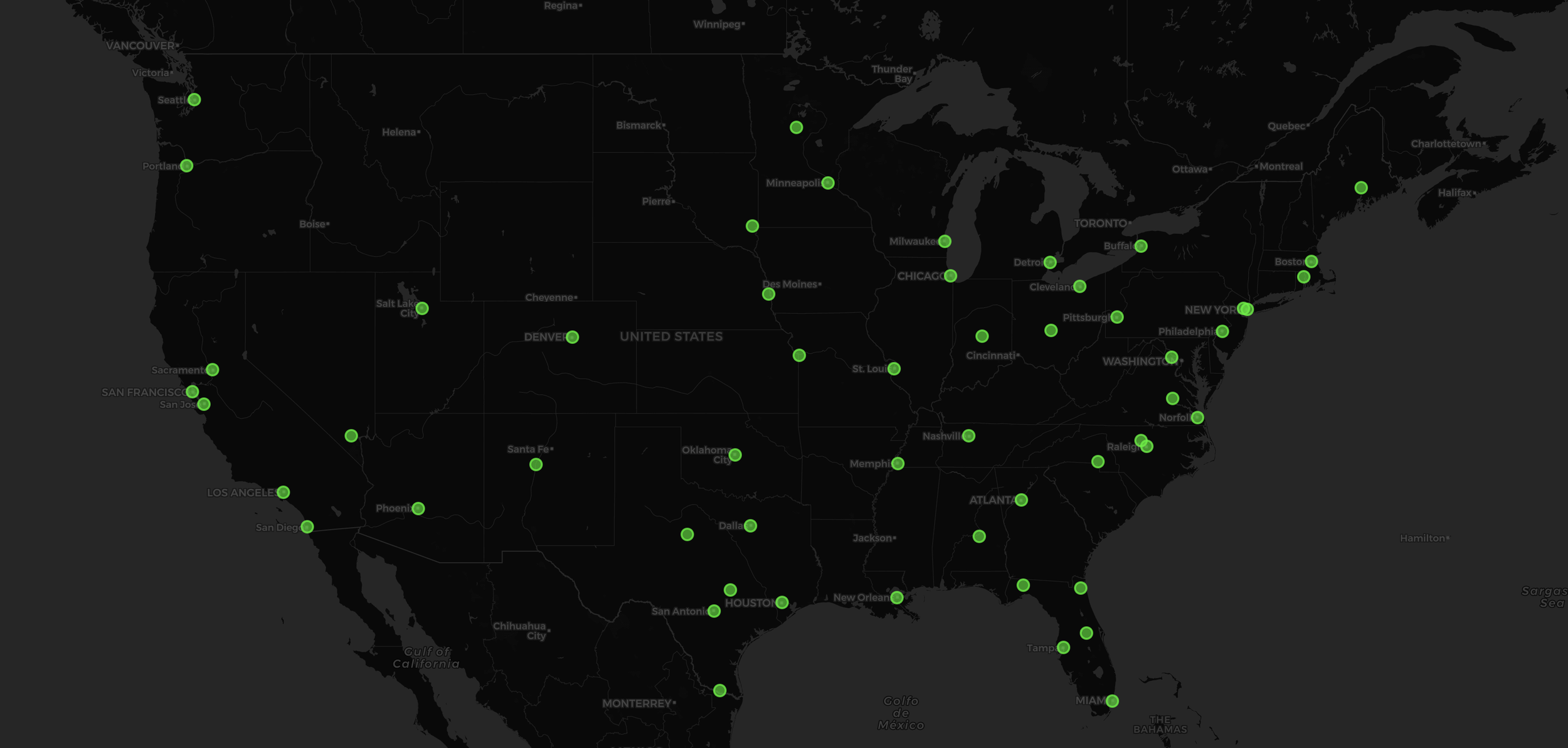
Our 4-hour SLA coverage spans the world's hottest data center construction markets: Phoenix, Dallas, Atlanta, Columbus, Salt Lake City, Memphis, Las Vegas, Raleigh-Durham (US hyper-scale boom towns); Ashburn/Northern Virginia (data center capital of the world); Singapore, Jakarta, Kuala Lumpur, Bangkok (Southeast Asia's data center explosion); Frankfurt, Amsterdam, Dublin, London (EMEA's FLAP markets); plus emerging powerhouses like Mumbai, São Paulo, and Mexico City.
Special coverage includes Austin (an AI startup hub), Johor Bahru (Malaysia's hyperscale magnet), and Tokyo/Osaka (Japan's dual data center cores).
Explore all 257 locations and check SLA coverage on our interactive map →
References
- Ray Kurzweil, The Singularity Is Near: When Humans Transcend Biology (New York: Viking, 2005)