Well, that escalated quickly. Three weeks ago, Elon Musk and xAI dropped Grok 4 on an unsuspecting world, and the benchmarks continue to make seasoned AI researchers do double-takes. Picture an AI that reasons through problems like a caffeinated team of PhDs brainstorming at 3 AM. Now that the initial hype has settled and developers have put Grok 4 through its paces, let me walk you through why this model represents more than another release—it's a glimpse into a future where AI becomes a true intellectual partner.
https://x.com/xai/status/1943158495588815072
The Launch That Broke the Internet (and Some Records)
xAI unveiled Grok 4 on July 9, 2025, through a livestream that drew 1.5 million viewers—not bad for a technical presentation at night.¹ The timing was...interesting, coming just one day after Grok 3 made headlines for all the wrong reasons with some controversial outputs.² But xAI decided the best defense was an overwhelming offense.
Musk introduced two variants: standard Grok 4 and Grok 4 Heavy, the latter deploying multiple AI agents that cross-check each other's work like a study group where everyone did the reading.³ Access runs through the Grok app, website, or API, with Heavy exclusive to SuperGrok Heavy subscribers at $300/month—a price point that says "we're serious about this."⁴ For the curious: https://x.ai/grok for general access, https://x.ai/api for developers.
Features That Make Other AIs Look Like Calculators
Grok 4 packs a 256,000-token context window (that's roughly a novel's worth of text it can process at once), image analysis, function calling, and voice modes so natural you might forget you're talking to silicon.⁵ But here's where it gets spicy: native tool use. xAI trained this beast with reinforcement learning to wield a code interpreter and web browser—like extensions of its mind.
Real-time search across X, the web, and news keeps responses fresh—no more "my knowledge cutoff" excuses. The multimodal capabilities let it seamlessly blend text and vision analysis, while Voice Mode adds scene analysis through your camera.⁶ For the enterprise folks sweating about compliance: SOC 2 Type 2, GDPR, and CCPA are all checked off. It's like having a witty research assistant who never sleeps, never complains about overtime, and understands your terrible handwriting.
The Secret Sauce: When Brute Force Meets Finesse
Behind Grok 4's magic lies xAI's Colossus supercomputer—a 200,000-GPU monster that makes most data centers look like pocket calculators.⁷ But raw power doesn't tell the whole story. xAI revolutionized their approach by scaling reinforcement learning to match pre-training compute, focusing on verifiable data from math, coding, and scientific domains, which boosted efficiency by 6x, transforming computational muscle into refined intelligence.⁸
The real innovation? They spent as much on post-training reinforcement learning as pre-training itself.⁹ Grok 4 Heavy takes the approach further with parallel test-time compute—multiple AI agents tackling problems simultaneously before comparing notes. Imagine upgrading from a solo garage inventor to a synchronized orchestra of Nobel laureates, each checking the others' work.
The Infrastructure Reality Check
The Colossus supercomputer has 200,000 GPUs, which is just... I can't even wrap my head around that number. Most companies are thrilled when they get a cluster with a few hundred GPUs working smoothly. But 200,000? The heat output alone would be like running a small power plant.
And that's before you even think about getting them all appropriately connected, keeping them fed with data, making sure your power grid doesn't just nope out on you.... Every detail matters: how you arrange the racks, what kind of cooling you use (and yeah, you need serious cooling because these things get HOT), plus all the networking and power distribution nightmares that come with it. Mess up any piece of that puzzle, and you're burning money on underperforming hardware. Companies looking to build their own AI infrastructure, whether it's 10 GPUs or 10,000,000, need expertise in everything from power distribution to the intricate fiber optic connections that keep data flowing at light speed. Here's the point where professional infrastructure deployment makes the difference between theoretical specs and real-world performance. As the team at Introl knows from deploying countless AI clusters, the devil truly is in the details—proper infrastructure can mean the difference between GPUs running at 95% efficiency versus leaving 30% of your performance on the table.
Numbers That Make Statisticians Weep With Joy
Let's dive into the benchmarks that have the AI community buzzing. On the notoriously brutal ARC-AGI-2 test—where models must demonstrate abstract reasoning with minimal examples—Grok 4 (Thinking mode) claims the throne with 15.9% at about $4 per task.¹⁰ That nearly doubles Claude Opus 4's 8.6%, and before you scoff at "only 15.9%," remember that most models struggle to break 5% on this test.¹¹ It's like watching someone solve Rubik's cubes blindfolded while everyone else is still figuring out which side is red.
The scaling experiments reveal something fascinating. With training compute alone, Grok 4 hits around 50% on Humanity's Last Exam (text-only subset). Add tools, and it jumps to 50.7%.¹² Test-time scaling plateaus near 50%, proving that more innovative inference strategies—not just throwing more compute at problems—drive breakthroughs.
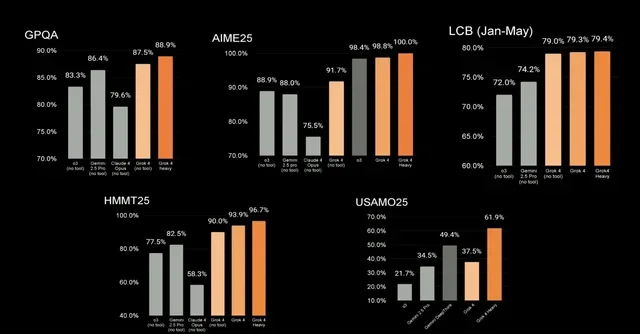
On AIME25 (American Invitational Mathematics Examination), Grok 4 Heavy achieves a perfect 100%, leaving Claude 4 Opus (75.5%) and Gemini 2.5 Pro (88.0%) in the dust.¹³ Even without tools, standard Grok 4 scores 91.7%—that's better than most human math competition participants.
But here's the showstopper: Humanity's Last Exam (complete set). The 2,500+ question gauntlet across STEM and humanities separates memorization from genuine reasoning.¹⁴ Grok 4 Heavy scores 44.4%, nearly doubling Gemini 2.5 Pro's 25.4% and more than doubling o3's 21.0%.¹⁵ When your AI outperforms others by such margins, you're not iterating—you're revolutionizing.
Real-World Performance That Matters
Beyond academic benchmarks, Grok 4 dominates practical tests. On Vending-Bench (yes, that's a real benchmark about optimizing vending machine operations), it achieves a net worth of $4,694 with 4,569 units sold—more than double Claude Opus 4's $2,077 and quintuple human performance at $844.¹⁶
Additional victories: USAMO'25 (61.9%), GPQA Diamond (88%), LiveCodeBench (79.4%), and MMLU-Pro (87%).¹⁷ Independent evaluators at Artificial Analysis crown Grok 4 with a 73 on their Intelligence Index, edging out OpenAI's o3 and Google's Gemini 2.5 Pro (both at 70).¹⁸ Not bad for a model that appeared just three weeks ago.
The Community Verdict: Excited, Skeptical, and Everything Between
Since launch, X (formerly Twitter) has become a testing ground for Grok 4's capabilities. Developers report pasting entire codebases for debugging, with results that outperform specialized tools like Cursor.¹⁹ One user called it "the closest thing to AGI yet," while scientists query unsolved materials problems and receive novel insights that check out.²⁰ After three weeks of real-world usage, patterns have emerged: the model excels at complex reasoning tasks but shows interesting quirks in creative applications.
But it's not all standing ovations. Users note speed limitations at 75 tokens/second (respectable but not blazing), and content moderation remains minimal—Grok 4 is less filtered than competitors, sparking debates about AI neutrality versus safety.²¹ Some appreciate the raw, unvarnished responses; others worry about potential misuse. Democracy in action, folks.
What This Means for Tomorrow (Spoiler: Everything Changes)
Here's where my optimism kicks into overdrive. Grok 4 transcends the chatbot category—it's a preview of AI as an intellectual partner. When an AI scores PhD-level on math competitions and helps scientists explore unsolved problems, we're witnessing the dawn of augmented discovery.
For Science: Imagine researchers worldwide with Access to an AI that genuinely understands complex mathematics and can propose novel hypotheses. Drug discovery, climate modeling, and materials science—all accelerated.
For Engineering: Beyond debugging, we're talking about AI that comprehends system architectures and can suggest optimizations humans might never consider. It's like having Dijkstra and Turing on speed dial.
For Education: Personalized tutoring that adapts not just to what students get wrong, but to how they think. Every learner receives a patient, brilliant mentor tailored to their cognitive style.
For Business: From strategic planning to market analysis, Grok 4's reasoning capabilities could transform decision-making from gut feelings to data-driven insights with a nuanced understanding.
The Caveats (Because Honesty Beats Hype)
Let's keep it real—no AI is perfect, and Grok 4 has room to grow. The 75 tokens/second speed won't win any races against specialized inference servers. Hallucinations, while reduced, haven't vanished entirely (an industry-wide challenge). The minimal content filtering raises valid concerns about misuse potential.
Look, xAI hasn't told us squat about their training data, and that's... not great. We all know how this goes—the data's biases get amplified when you scale this big. Everyone in AI is watching xAI like hawks right now. How do they handle the ethics piece as Grok 4 spreads? That's going to matter—a lot.
The Road Ahead: Things Are About to Get Weird
So, xAI showed some of their plans during the presentation, and one thing completely blew my mind. They mentioned connecting Grok to Tesla's computational fluid dynamics software—the same CFD that Tesla engineers use for aerodynamics and thermal management on actual vehicles.²²
I had to sit with that for a minute. We've grown accustomed to AI that knows facts, answers questions, and writes code. But the CFD integration represents something different. It's one thing to have an AI that can explain how fluid dynamics works. It's something else entirely when that AI can use CFD software to design things that move through air and dissipate heat. That's not incremental progress—that's an entirely new capability.
OpenAI, Anthropic, and Google aren't going to watch from the sidelines. But Grok 4 changed the game—we went from "helpful assistant" territory straight to "reasoning partner." The shift reminds me of what Ray Kurzweil talks about with the intelligence explosion—each breakthrough making the next one happen faster and faster. We're watching it happen in real time.
Your Turn: What Will You Build?
So I've been thinking—what happens when AI can reason at a PhD level across the board? What problems that seemed impossible suddenly crack wide open? What do we discover when our tools can think alongside us? And honestly, what kind of guardrails do we need to put up when AI gets this smart?
If you're a developer, you're already planning what to build with those APIs. Researchers are probably having a field day thinking about what's suddenly possible. And if you're sitting here thinking, "What does Grok 4's capability even mean?"—yeah, I get it. The concept takes time to process.
But here's the thing: Grok 4 landed in our laps whether we're ready or not. AI just said, "Here's what's possible now, figure out what to do with it."
So... what ARE you going to do with it? The Grok API is at https://x.ai/api, and there's a whole community on X where developers and researchers are already pushing the limits. Three weeks in, we're seeing applications nobody predicted at launch. The opportunity here is massive—let's not waste it.
References
-
Scott Rosenberg, "Elon Musk's xAI debuts Grok 4, 'smartest AI in the world,'" Axios, July 10, 2025, https://www.axios.com/2025/07/10/grok4-grok-xai-elon-musk.
-
"Musk unveils Grok 4 update a day after xAI chatbot made antisemitic remarks," CBS News, July 10, 2025, https://www.cbsnews.com/news/elon-musk-grok-4-ai-chatbot-x/.
-
"Elon Musk's xAI launches Grok 4 alongside a $300 monthly subscription," TechCrunch, July 9, 2025, https://techcrunch.com/2025/07/09/elon-musks-xai-launches-grok-4-alongside-a-300-monthly-subscription/.
-
"Elon Musk's xAI launches Grok 4 alongside a $300 monthly subscription," TechCrunch.
-
xAI, "Grok 4 Release Announcement," livestream presentation, July 9, 2025.
-
xAI, "Grok 4 Release Announcement."
-
"Grok 4 Release: xAI Claims #1 AI Model Crown in Independent Testing," Gear Musk, July 10, 2025, https://gearmusk.com/2025/07/10/xai-unveils-grok-4/.
-
xAI, "Grok 4 Release Announcement."
-
"Musk's Grok-4 Crushes Benchmarks, Beats OpenAI & Google in RL," Analytics India Magazine, July 10, 2025, https://analyticsindiamag.com/global-tech/musks-grok-4-crushes-benchmarks-beats-openai-google-in-rl/.
-
"ARC Prize," X (formerly Twitter), July 10, 2025, [https://twitter.com/arcprize/status/specific-id].
-
François Chollet, "ARC-AGI: A New Frontier in AI Reasoning," ARC Prize Organization, 2025.
-
xAI, "Grok 4 Release Announcement."
-
"Elon Musk's Grok 4 AI Models Set New Benchmark Records," Beebom, July 10, 2025, https://beebom.com/elon-musk-grok-4-ai-models-set-new-benchmark-records/.
-
"xAI sets AI benchmark records with new reasoning-optimized Grok 4 model," SiliconANGLE, July 10, 2025, https://siliconangle.com/2025/07/10/xai-sets-ai-benchmark-records-new-reasoning-optimized-grok-4-model/.
-
xAI, "Grok 4 Release Announcement."
-
xAI, "Grok 4 Release Announcement."
-
xAI, "Grok 4 Release Announcement."
-
"Comparison of AI Models across Intelligence, Performance, Price," Artificial Analysis, accessed July 11, 2025, https://artificialanalysis.ai/models.
-
User testimonials, X (formerly Twitter), July 10-11, 2025.
-
User testimonials, X (formerly Twitter), July 10-11, 2025.
-
"What's New in Grok 4? Release Facts, Benchmarks, and Value," SmythOS, July 10, 2025, https://smythos.com/developers/ai-models/whats-new-in-grok-4-release-facts-benchmarks-and-value/.
-
xAI, "Grok 4 Release Announcement."