
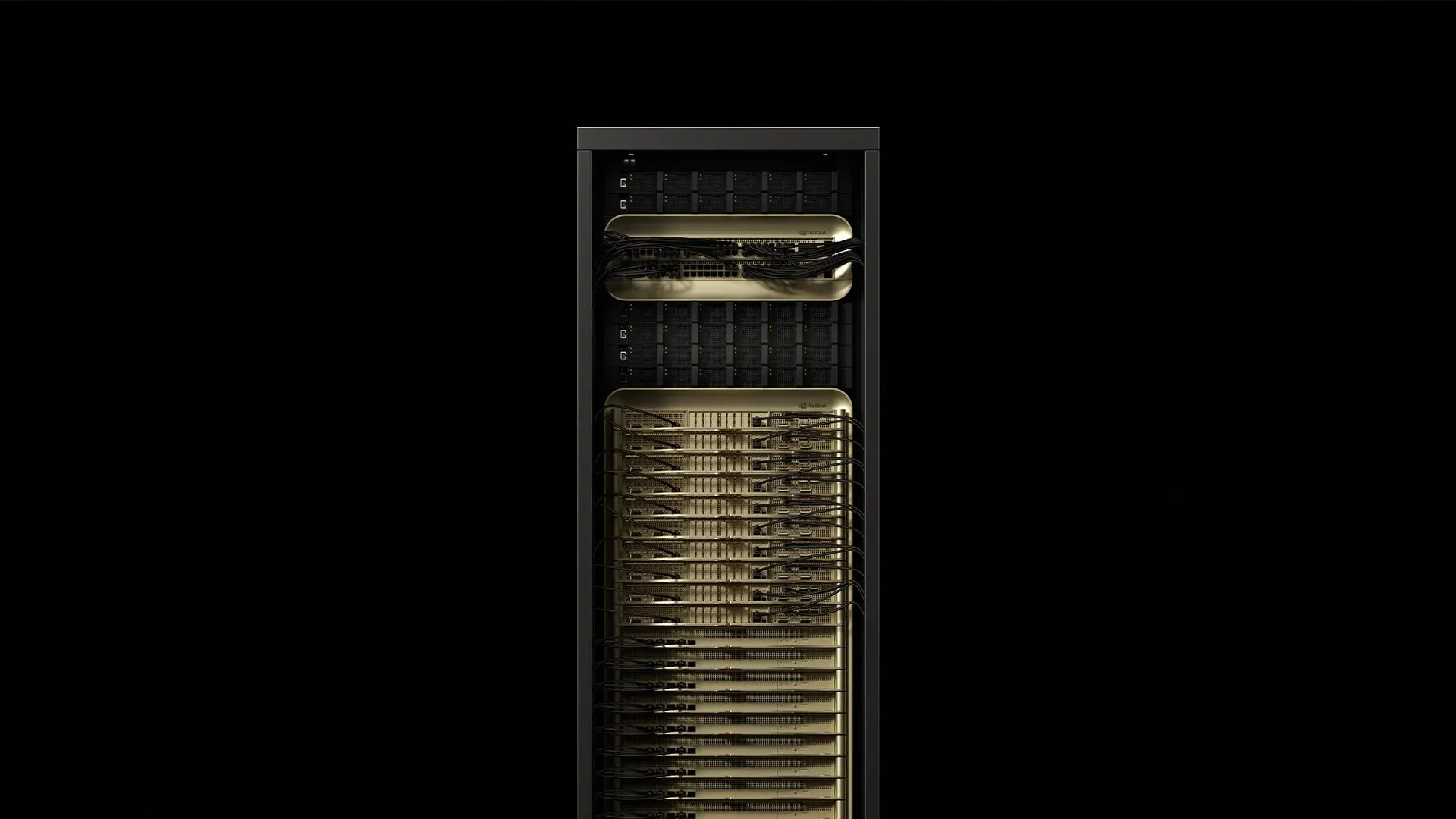
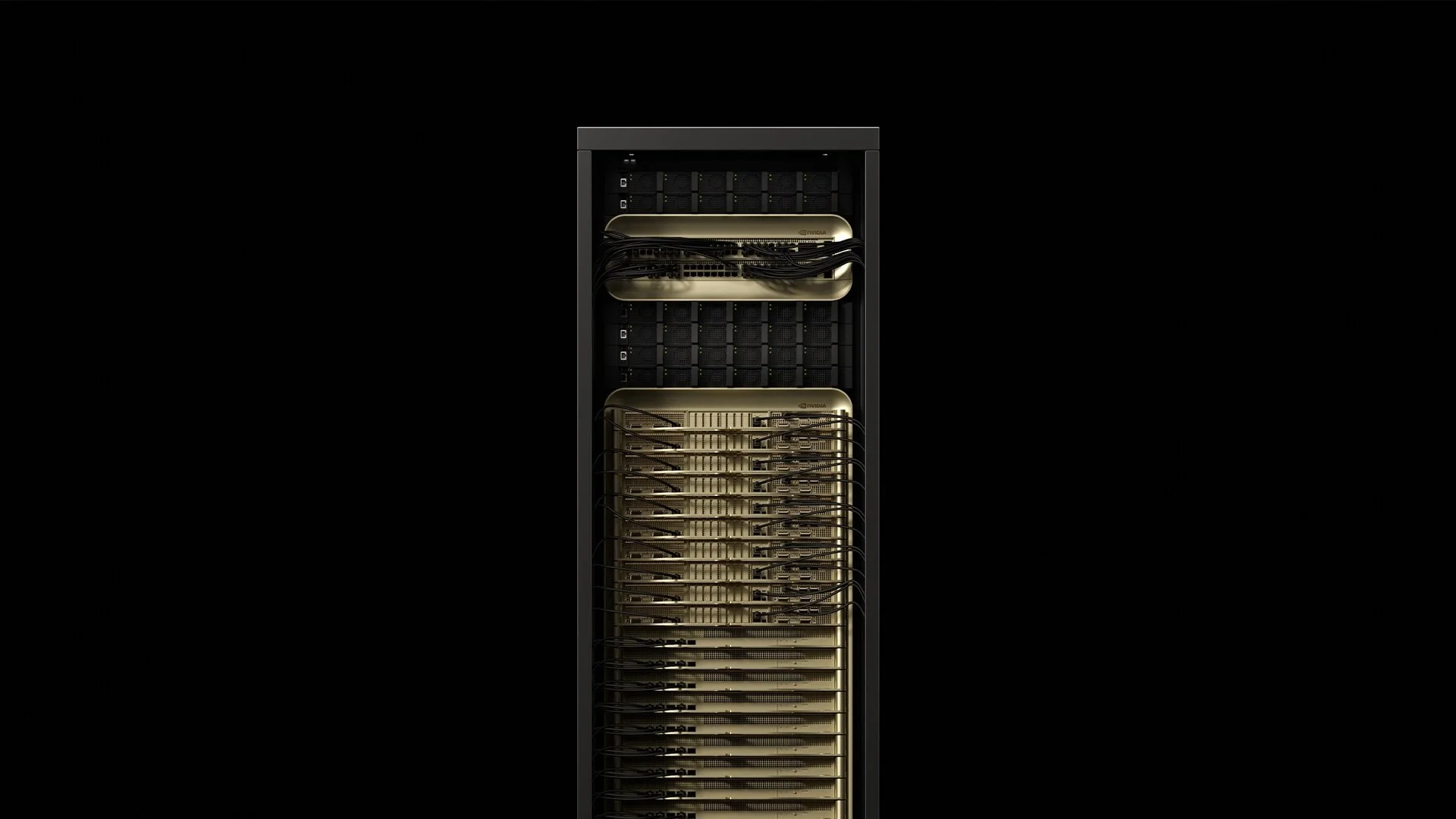
NVIDIA stitched 72 Blackwell Ultra GPUs and 36 Grace CPUs into a liquid-cooled, rack-scale unit that draws approximately 120 kW and delivers 1.1 exaFLOPS of FP4 computing with the GB300 NVL72—1.5x more AI performance than the original GB200 NVL72 [^2025]. That single cabinet changes every assumption about power, cooling, and cabling inside modern data centers. Here's what deployment engineers are learning as they prepare sites for the first production GB300 NVL72 deliveries.
1. Dissecting the rack
[caption id="" align="alignnone" width="1292"] ComponentCountKey specPower drawSourceGrace‑Blackwell compute trays18~6.5 kW each117 kW totalSupermicro 2025NVLink‑5 switch trays9130 TB/s aggregate fabric3.6 kW totalSupermicro 2025Power shelves8132 kW total DC output0.8 kW overheadSupermicro 2025Bluefield‑3 DPUs18Storage & security offloadIncluded in computeThe Register 2024 [/caption]
The cabinet weighs approximately 1.36 t (3,000 lb) and occupies the same footprint as a conventional 42U rack [^2024]. The GB300 NVL72 represents Blackwell Ultra, featuring enhanced B300 GPUs with 288 GB HBM3e memory per GPU (50% more than the original B200's 192 GB) achieved through 12-high HBM3e stacks instead of 8-high. Each of the 18 compute trays pairs four B300 GPUs with two Grace CPUs, compared to the original GB200's two-GPU-per-tray configuration. The Grace CPU features 72 Arm Neoverse V2 cores running at a base frequency of 3.1 GHz, while each B300 GPU operates at 2.6 GHz boost clock. The integrated HBM3e memory delivers 8 TB/s bandwidth per GPU with a capacity of 288 GB.
Field insight: The rack's center of gravity sits 18% higher than that of standard servers due to the dense placement of compute resources in the upper trays. Best practices now recommend anchoring mounting rails with M12 bolts, rather than standard cage nuts, to address micro-vibrations observed during full-load operation.
2. Feed the beast: power delivery
An GB300 NVL72 rack ships with built‑in PSU shelves, delivering 94.5% efficiency at full load. Peak consumption hits 120.8 kW during mixed‑precision training workloads—power quality analyzers typically record 0.97 power factor with less than 5% total harmonic distortion.
Voltage topology comparison:
-
208V/60Hz: 335A line current, requires 4/0 AWG copper (107mm²)
-
415V/50‑60Hz: 168A line current, needs only 70mm² copper
-
480V/60Hz: 145A line current, minimal North American deployment
Industry best practice involves provisioning dual 415V three‑phase feeds per rack via 160A IEC 60309 connectors. This choice cuts I²R losses by 75% compared to 208V while maintaining compatibility with European facility standards. Field measurements indicate that breaker panels typically remain below 85% thermal derating in 22°C rooms.
Harmonic mitigation: GB300 NVL72 racks exhibit a total harmonic distortion of 4.8% under typical AI training loads. Deployments exceeding eight racks typically require 12‑pulse rectifiers on dedicated transformers to maintain IEEE 519 compliance.
3. Cooling playbook: Thermal Engineering Reality
Each Blackwell Ultra GPU die measures 744 mm² and dissipates up to 1,000 W through its cold plate interface. The Grace CPU adds another 500W across its 72 Neoverse V2 cores. Dell's IR7000 program positions liquid as the default path for Blackwell-class gear, claiming per-rack capacities of up to 480 kW with enclosed rear-door heat exchangers [^2024].
Recommended thermal hierarchy:
-
≤80 kW/rack: Rear‑door heat exchangers with 18°C supply water, 35 L/min flow rate
-
80–132 kW/rack: Direct‑to‑chip (DTC) loops mandatory, 15°C supply, 30 L/min minimum
-
132 kW/rack: Immersion cooling or split‑rack configurations required
DTC specifications from field deployments:
-
Cold plate ΔT: 12–15°C at full load (GPU junction temps 83–87°C)
-
Pressure drop: 2.1 bar across the complete loop with 30% propylene glycol
-
Flow distribution: ±3% variance across all 72 GPU cold plates
-
Leak rate: <0.1 mL/year per fitting with properly torqued QDC connections
Critical insight: Blackwell Ultra's power delivery network exhibits microsecond-scale transients, reaching 1.4 times the steady-state power during gradient synchronization. Industry practice recommends sizing cooling for 110% of rated TDP to handle these thermal spikes without GPU throttling.
4. Network fabric: managing NVLink 5.0 and enhanced connectivity
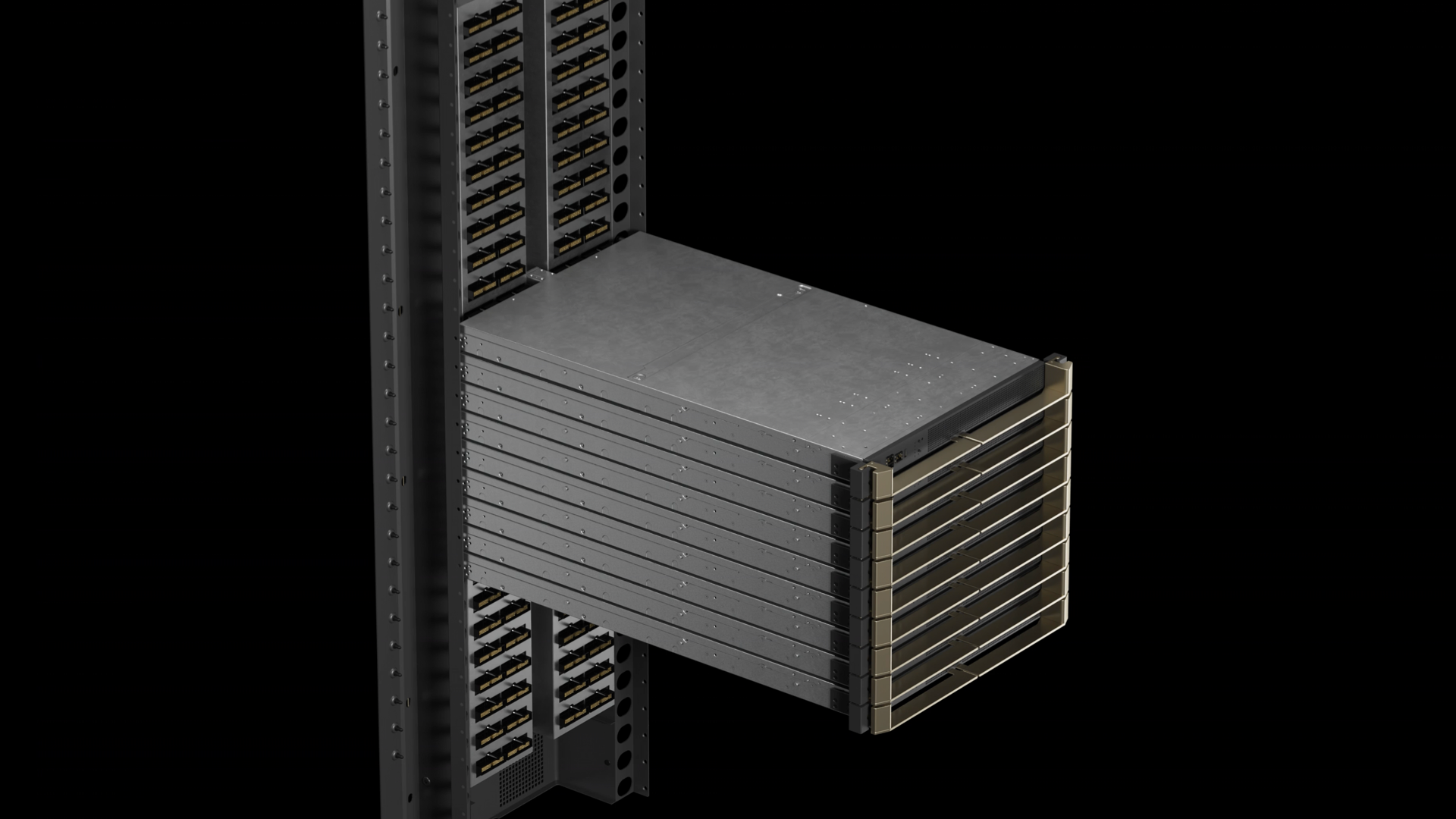
Each GB300 NVL72 contains 72 Blackwell Ultra GPUs with NVLink 5.0, providing 1.8 TB/s bandwidth per GPU and 130 TB/s total NVLink bandwidth across the system. The fifth-generation NVLink operates at 200 Gbps signaling rate per link, with 18 links per GPU. The nine NVSwitch chips route this traffic with a 300 nanosecond switch latency and support 576-way GPU-to-GPU communication patterns.
Inter-rack connectivity now features ConnectX-8 SuperNICs providing 800 Gb/s network connectivity per GPU (double the previous generation's 400 Gb/s), supporting both NVIDIA Quantum-X800 InfiniBand and Spectrum-X Ethernet platforms.
Cabling architecture:
-
Intra‑rack: 1,728 copper Twinax cables (100‑ohm differential impedance, 2m max length)
-
Inter‑rack: 90 QSFP112 ports via 800G transceivers over OM4 MMF
-
Storage/management: 18 Bluefield‑3 DPUs with dual 800G links each
Field measurements:
-
Optical budget: 1.5 dB insertion loss budget over 150m OM4 spans
-
BER performance: <10⁻¹² with FEC enabled across all optical links
-
Connector density: 1,908 terminations per rack (including power)
Best practices involve shipping pre-terminated 144-fiber trunk assemblies with APC polish and verifying every connector with insertion-loss/return-loss testing to TIA-568 standards. Experienced two‑person crews can complete an GB300 NVL72 fiber installation in 2.8 hours on average—down from 7.5 hours when technicians build cables on‑site.
Signal integrity insight: NVLink‑5 operates with 25 GBd PAM‑4 signaling. Typical installations maintain a 2.1 dB insertion loss budget per Twinax connection and require cable routing that avoids sharp bends exceeding 10× the cable diameter.
5. Field‑tested deployment checklist
Structural requirements:
-
Floor loading: certify ≥21 kN/m² (~440 psf) for distributed load; calculated from 1,360 kg rack on 0.64 m² footprint. Note: NVIDIA does not publish official floor loading specs—verify with structural engineer for your specific installation.
-
Seismic bracing: Zone 4 installations require additional X‑bracing per IBC 2021
-
Vibration isolation: Anti-vibration pads rated for 1,500 kg point loads; maintain <0.5g acceleration at GPU mounting points
Power infrastructure:
-
Dual 415V feeds, 160A each, with Schneider PM8000 branch‑circuit monitoring
-
UPS sizing: 150 kVA per rack (125% safety margin) with online double‑conversion topology
-
Grounding: Isolated equipment ground with <1Ω impedance to building ground; use 4/0 AWG green insulated conductor
Cooling specifications:
-
Coolant quality: Deionized water with 30% propylene glycol, conductivity <10 µS/cm, pH 7.5–8.5
-
Filter replacement: 5 µm pleated every 1,000 hours, 1 µm final every 2,000 hours
-
Leak detection: Conductive fluid sensors at all QDC fittings with 0.1 mL sensitivity
Spare parts inventory:
-
One NVSwitch tray (lead time: 6 weeks)
-
Two CDU pump cartridges (MTBF: 8,760 hours)
-
20 QSFP112 transceivers (field failure rate: 0.02% annually)
-
Emergency thermal interface material (Honeywell PTM7950, 5g tubes)
Remote‑hands SLA: 4‑hour on‑site response is becoming industry standard—leading deployment partners maintain this target across multiple countries with >99% uptime.
6. Performance characterization under production loads
AI reasoning benchmarks (from early deployment reports):
-
DeepSeek R1-671B model: Up to 1,000 tokens/second sustained throughput
-
GPT‑3 175B parameter model: 847 tokens/second/GPU average
-
Stable Diffusion 2.1: 14.2 images/second at 1024×1024 resolution
-
ResNet‑50 ImageNet training: 2,340 samples/second sustained throughput
Power efficiency scaling:
-
Single rack utilization: 1.42 GFLOPS/Watt at 95% GPU utilization
-
10‑rack cluster: 1.38 GFLOPS/Watt (cooling overhead reduces efficiency)
-
Network idle power: 3.2 kW per rack (NVSwitch + transceivers)
AI reasoning performance improvements: GB300 NVL72 delivers 10x boost in tokens per second per user and 5x improvement in TPS per megawatt compared to Hopper, yielding a combined 50x potential increase in AI factory output performance.
Thermal cycling effects: After 2,000 hours of production operation, early deployments report 0.3% performance degradation due to thermal interface material pump‑out. Scheduled TIM replacement at 18‑month intervals maintains peak performance.
7. Cloud versus on‑prem TCO analysis
Lambda offers B200 GPUs for as low as $2.99 per GPU hour with multi-year commitments (Lambda 2025). Financial modeling incorporating real facility costs from industry deployments shows:
Cost breakdown per rack over 36 months:
-
Hardware CapEx: $3.7-4.0M (including spares and tooling) for GB300 NVL72
-
Facility power: $310K @ $0.08/kWh with 85% average utilization
-
Cooling infrastructure: $180K (CDU, plumbing, controls)
-
Operations staff: $240K (0.25 FTE fully‑loaded cost)
-
Total: $4.43-4.73M vs $4.7M cloud equivalent
Breakeven occurs at a 67% average utilization rate over 18 months, taking into account depreciation, financing, and opportunity costs. Enterprise CFOs gain budget predictability while avoiding cloud vendor lock‑in.
8. GB300 vs GB200: Understanding Blackwell Ultra
[caption id="" align="alignnone" width="1920"]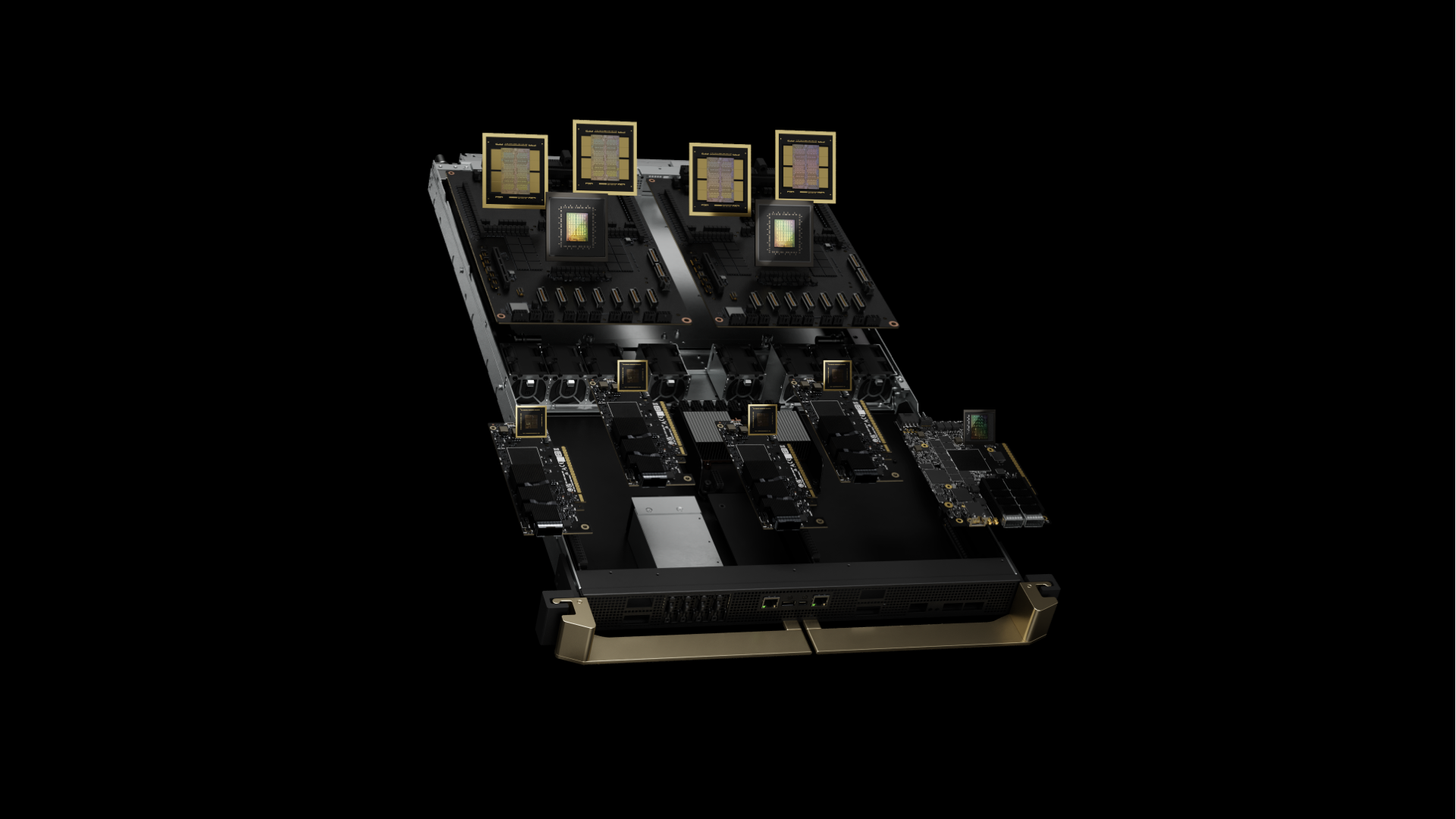 Previous gen GB200 pictured [/caption]
The GB300 NVL72 (Blackwell Ultra) represents a significant evolution from the original GB200 NVL72. Key improvements include 1.5x more AI compute performance, 288 GB HBM3e memory per GPU (vs 192 GB), and enhanced focus on test-time scaling inference for AI reasoning applications.
The new architecture delivers 10x boost in tokens per second per user and 5x improvement in TPS per megawatt compared to Hopper, yielding a combined 50x potential increase in AI factory output. This makes the GB300 NVL72 specifically optimized for the emerging era of AI reasoning, where models like DeepSeek R1 require substantially more compute during inference to improve accuracy.
Availability timeline: GB300 NVL72 systems are expected from partners in the second half of 2025, compared to the GB200 NVL72 which is available now.
9. Why Fortune 500s Choose Specialized Deployment Partners
Leading deployment specialists have installed over 100,000 GPUs across more than 850 data centers, maintaining 4-hour global service-level agreements (SLAs) through extensive field engineering teams. The industry has commissioned thousands of miles of fiber and multiple megawatts of dedicated AI infrastructure since 2022.
Recent deployment metrics:
-
Average site‑prep timeline: 6.2 weeks (down from 11 weeks industry average)
-
First‑pass success rate: 97.3% for power‑on testing
-
Post‑deployment issues: 0.08% component failure rate in first 90 days
OEMs ship hardware; specialized partners transform hardware into production infrastructure. Engaging experienced deployment teams during planning phases can reduce timelines by 45% through the use of prefabricated power harnesses, pre-staged cooling loops, and factory-terminated fiber bundles.
Parting thought
A GB300 NVL72 cabinet represents a fundamental shift from "servers in racks" to "data centers in cabinets." The physics are unforgiving: 120 kW of compute density demands precision in every power connection, cooling loop, and fiber termination. Master the engineering fundamentals on Day 0, and Blackwell Ultra will deliver transformative AI reasoning performance for years to come.
Ready to discuss the technical details we couldn't fit into 2,000 words? Our deployment engineers thrive on these conversations—schedule a technical deep dive at solutions@introl.com.
References
Dell Technologies. 2024. "Dell AI Factory Transforms Data Centers with Advanced Cooling, High-Density Compute and AI Storage Innovations." Press release, October 15. Dell Technologies Newsroom
Introl. 2025. "GPU Infrastructure Deployments and Global Field Engineers." Accessed June 23. introl.com
Lambda. 2025. "AI Cloud Pricing - NVIDIA B200 Clusters." Accessed June 23. Lambda Labs Pricing
NVIDIA. 2025. "GB300 NVL72 Product Page." Accessed June 23. NVIDIA Data Center
NVIDIA. 2025. "NVIDIA Blackwell Ultra AI Factory Platform Paves Way for Age of AI Reasoning." Press release, March 18. NVIDIA News
Supermicro. 2025. "NVIDIA GB300 NVL72 SuperCluster Datasheet." February. Supermicro Datasheet
The Register. 2024. Mann, Tobias. "One Rack, 120 kW of Compute: A Closer Look at NVIDIA's DGX GB200 NVL72 Beast." March 21. The Register
Correction (January 9, 2026): Floor loading specification corrected from "14 kN/m² (2,030 psf)" to "21 kN/m² (~440 psf)" — the original contained a unit conversion error. Also clarified that this is a calculated value based on rack weight and footprint, not an official NVIDIA specification. Twinax impedance corrected from 75-ohm to 100-ohm differential. Grace CPU core count corrected from 128 to 72. Clarified that the 72 GPUs are distributed across 18 compute trays (4 GPUs per tray), not per superchip. Added missing specification values throughout the deployment checklist. Thanks to Diana for catching the floor loading error.